Governance that runs on evidence, not documentation.
One idea, applied to two domains. Our ESG Governance and AI Governance divisions each pair an instrumented methodology with the platform that supplies its evidence — and everything is designed, engineered and operated by RAMA Technologies, alongside the software we build for businesses and individuals.
All product downloads are delivered via flintzoo.com — our Cloudflare-fronted distribution platform.
Division 01ESG Governance
Disclosure you can defend
Mandatory climate reporting is live for its second cohort, the third follows from 1 July 2027, and statutory assurance moves from limited review to full audit by 2030. For most mid-sized Australian entities it is the first time a non-financial report carries a directors' declaration and an auditor's opinion.
ESG reporting practice
ESG Reporting
What must we report, what does it mean for the business — and can we evidence it?
Three questions decide whether an organisation is ready for mandatory sustainability reporting, and most start with the second without finishing the first. We treat the third — can we evidence it — as a design problem rather than a reporting one, and build the controlled system behind the report.
The approach
Determine before you measure — applicability established on the consolidated figures and the statutory tests, signed by legal and finance, before a single metric is defined
One controlled evidence system, several outputs — the sustainability report, NGER return, Modern Slavery statement and customer questionnaires draw on the same sources, with boundary differences reconciled rather than forced to match
Scoring on evidence, not intention — readiness judged on what can be shown to have operated in the period
A gate before every lodgement — legal scope, ownership, reconciliation, governance evidence and the evidence pack confirmed before anything is approved
Findings embedded, not filed — what the assurance practitioner finds becomes next cycle's controls
Governance proportionate to the entity — a Group 3 services firm and a Group 1 miner need the same discipline at very different intensities
What an engagement produces
A signed applicability record · one obligation register across all four layers with owners and due dates · a reporting calendar · a reconciliation of the financial, emissions and statutory boundaries · a dictionary of every reported metric with its owner, source, method and assurance status · a map from every required disclosure to its evidence · an assurance-ready pack assembled before the practitioner asks.
How it starts
Executive briefing (45 minutes) — the landscape, the failure modes and the approach
Applicability workshop (half day) — with legal, finance, HR, procurement, operations and sustainability leads; produces the signed applicability record, obligation register and reporting calendar
Readiness diagnostic — interviews and evidence review scoring your reporting controls on what can be shown, with a prioritised gap register and roadmap
Design, build and cycle support — the evidence chain and the dashboard configured for your entity; then the pre-lodgement gate and post-lodgement review, every reporting season
The presentation layer of a controlled reporting system — not the system.
One view, per entity and by industry, of what applies, what is due, what is assured and how much evidence stands behind it. A dashboard built before definitions, boundaries, owners, source provenance and approval controls exist reproduces every weakness underneath it — so this one is configured only once the evidence chain is in place.
What it shows
Obligation register — every obligation across the four layers with its determination, test, due date and owner
Reporting calendar — countdowns to each statutory deadline with lead-time milestones
Assurance tracker — the assurance stage your cohort is in this year and next, and what it covers
Industry overlay — material topics, standards and candidate metrics for your industry, with data coverage
Readiness and gate status — where the reporting controls stand, and whether the last pre-lodgement gate passed
Evidence completeness — how much of the report is covered by the evidence chain, link by link
Emissions summary — gross figures with measured-versus-estimated flags; never netted
How it is protected
Australian data residency for storage and database
Multi-factor authentication for every user; single sign-on for enterprise tenants; role-based access
Each client's data isolated at the database level, with automated cross-tenant tests on every release
Append-only audit log and a hash-chained evidence vault — who did what, when, and proof that evidence has not been altered
Controls aligned with the ACSC Essential Eight, ISO/IEC 27001 and OWASP ASVS — alignment, not certification — with independent penetration testing before go-live and annually
Workforce metrics held as aggregates only; no individual payroll data by design
The dashboard presents your system of record. It is not the statutory lodgement system, and it is not a substitute for your auditor.
Published / lodgedreport, filing receipt, assurance report
Each link retains versions and a correction history. The chain is what an assurance practitioner walks — in reverse, from the published figure to the source record — and the dashboard shows how much of the report is covered by it.
Boundary. RAMA Technologies does not provide legal advice: whether an obligation applies is confirmed by your legal and finance functions. RAMA Technologies does not provide statutory assurance: for a Chapter 2M sustainability report your financial-report auditor provides it. We prepare you for it and keep the evidence chain visible.
ESG Reporting · Regulatory timeline
Which dates apply depends on which layer you are in.
Australian ESG obligations run on separate legal tests, portals and clocks. Select a layer to see its target dates and the standard or regulation behind each one.
Layer 1 — Mandatory climate disclosure
Corporations Act 2001 (Cth) Chapter 2M and s 292A · AASB S2 Climate-related Disclosures · ASIC RG 280
Entities required to lodge a Chapter 2M financial report enter the sustainability-report regime by cohort — two of three size thresholds, the NGER-reporter pathway, or the asset-owner test. AASB S1 remains voluntary.
Layer 1 target dates and governing instruments
Date
What happens
Standard / regulation
Status
Financial years beginning on or after 1 January 2025
Group 1 commences (revenue ≥ A$500m · gross assets ≥ A$1bn · employees ≥ 500, meet two of three; or NGER controlling corporation meeting the corporate-group threshold)
Relief from Scope 3 emissions disclosure and from comparative information; Scope 3 becomes a required disclosure from the second year
AASB S2 Appendix C (transition provisions)
M
3 months after year end (disclosing entities, registered schemes, RSEs) · 4 months (other entities)
Lodgement of the sustainability report with the auditor's report
Corporations Act s 319; ASIC lodgement guidance
M
Periods beginning on or after 1 January 2027
The September 2024 AASB S2 compilation ceases to apply; the later compilation (including S2025-1 greenhouse-gas amendments) governs
AASB S2 compilation history; AASB S2025-1
T
Mid-2026 consultation
Treasury consulted on possible changes to reporting thresholds and assurance phasing — a proposal, not an amendment; published settings continue to apply
Each filing runs on its own legal test, portal, deadline and signatory. Lodging a sustainability report discharges none of them.
Layer 2 target dates and governing instruments
Date
What happens
Standard / regulation
Status
31 October each year
NGER emissions and energy report for the preceding financial year (facility ≥ 25,000 t CO2-e or 100 TJ; corporate group ≥ 50,000 t CO2-e or 200 TJ)
National Greenhouse and Energy Reporting Act 2007; NGER Regulations 2008; NGER (Measurement) Determination 2008 (updated annually); Clean Energy Regulator
M
Annually to 30 June 2030
Safeguard Mechanism baseline decline of 4.9% per year for covered facilities (generally > 100,000 t CO2-e direct emissions), subject to scheme exceptions
NGER Act 2007 Part 3H; Safeguard Mechanism Rule; Clean Energy Regulator
M
Within 6 months of financial year end (31 December for June year-ends)
Modern Slavery statement for entities with consolidated revenue ≥ A$100m, approved by the governing body and signed by a responsible member
Modern Slavery Act 2018 (Cth) ss 5, 13–16; Attorney-General's Department
M
1 April – 31 May each year
WGEA report against the six Gender Equality Indicators for relevant employers with 100 or more employees; additional strategy and target requirements at 500 or more
APRA-regulated institutions: climate-risk governance expectations supporting the enforceable prudential standards — not a standalone public reporting mandate
APRA CPG 229
G
Layer 3 — Voluntary, market and international
GRI · SASB / ISSB (IFRS S1, S2) · TNFD · PCAF · CDP · EU CSRD, ESRS and CBAM · UK SRS · US SEC and California · NZ, SGX and HKEX regimes
Screening overlays for groups with overseas entities, listings, exports or value-chain commitments. Dates below are stated as published; most changed during 2026 and are flagged T until re-verified for the reporting period.
GRI 102 Climate Change 2025 and GRI 103 Energy 2025 effective, replacing specified GRI 305 and GRI 302 disclosures
GRI Topic Standards
V
Reporting from 1 January 2023
GRI Universal Standards 2021 (GRI 1, 2, 3) in effect
GRI Universal Standards
V
1 January 2026
EU CBAM definitive regime: authorisation, embedded-emissions data and certificates for covered imports; Australian exporters may be asked for installation-level data
EU Regulation 2023/956 (CBAM)
M
24 February 2026 · 3 July 2026
EU CSRD scope narrowed (> 1,000 employees and > €450m turnover; separate third-country tests); revised ESRS adopted by the Commission
EU CSRD; ESRS (revised)
T
25 February 2026
UK SRS S1 and S2 issued; legal application to be assessed separately
UK Sustainability Reporting Standards
T
Financial years beginning on or after 6 April 2022
UK mandatory climate-related financial disclosures for covered companies and LLPs
US SEC proposed rescission of its climate-disclosure rules (stayed since April 2024)
SEC rulemaking
T
10 August 2026
California SB 253 first-year greenhouse-gas reporting deadline; SB 261 enforcement of the 1 January 2026 deadline suspended under a court order
California SB 253 and SB 261; CARB regulations
T
Years commencing on or after 1 January 2026
HKEX climate disclosures mandatory for applicable LargeCap issuers
HKEX Listing Rules
M
Financial years commencing 2026
SGX Scope 3 reporting for specified STI constituent issuers; other cohorts phase in
SGX Listing Rules 711A/711B; Practice Note 7.6
CE
Periods ending on or after 27 October 2024
New Zealand greenhouse-gas assurance for climate reporting entities
NZ CS 1 paras 25–26; NZ SAE 1
M
Continuous
Supplier questionnaires, lender covenants and customer contracts create commercial reporting commitments without making a supplier a statutory reporting entity
Contractual terms; SASB, TNFD, PCAF and CDP as selected
V
Layer 4 — External assurance
ASSA 5000 General Requirements for Sustainability Assurance Engagements · ASSA 5010 Timeline for Audits and Reviews · Corporations Act 2001
ASSA 5000 says how assurance is performed; ASSA 5010 says what must be assured, at what level and when, by cohort. The statutory financial-report auditor provides it.
Layer 4 target dates and governing instruments
Date
What happens
Standard / regulation
Status
Group 1: FYs commencing 1 Jan 2025 – 30 Jun 2026 · Group 2: 1 Jul 2026 – 30 Jun 2027 · Group 3: 1 Jul 2027 – 30 Jun 2028
Stage 1 — limited assurance over governance, specified risk and opportunity disclosures, Scope 1 and 2 emissions and any no-material-risk statement
ASSA 5010 para 10(a)
M
Group 1: FYs commencing 1 Jul 2026 – 30 Jun 2028 · Group 2: 1 Jul 2027 – 30 Jun 2029 · Group 3: 1 Jul 2028 – 30 Jun 2030
Stages 2 and 3 — limited assurance over all disclosures in the sustainability report, including scenario analysis, transition plans, risk management, Scope 3 and targets
ASSA 5010 para 10(b)
M
Group 1: FYs commencing from 1 Jul 2028 · Group 2: from 1 Jul 2029 · Group 3: from 1 Jul 2030
Stage 4 — reasonable assurance (audit) over the sustainability report
ASSA 5010; Corporations Act requires audit for financial years commencing on or after 1 July 2030
M
Periods beginning from 1 January 2025 (Chapter 2M information) · other engagements from 31 December 2025
ASSA 5000 operative dates, as amended July 2025; information reported to the Clean Energy Regulator is assured under ASAE 3000 instead
ASSA 5000 (amended July 2025); AUASB implementation guidance
M
Periods beginning on or after 15 December 2026
ISSA 5000 international effective date (early application permitted); Australian timing follows ASSA 5000, not ISSA 5000
IAASB ISSA 5000
V
Mid-2026 consultation
Treasury consulted on possible changes to assurance phasing — ASSA 5010 as published remains the standard until amended
Treasury consultation (unenacted)
T
M
Mandatory for an entity, facility, product or activity meeting the applicable legal test
CE
Comply-or-explain: the explanation itself is required
V
Voluntary unless incorporated into a contract, listing rule or other binding requirement
G
Regulatory guidance supporting enforceable rules
T
Transition, proposal, litigation or implementation detail — requires further checking
Rule-set v1.0.0 · checked against Research handovers and RMAT-ESG-IM-000 dated 11 October 2026
Boundary. This timeline is general information, not legal advice and not an applicability determination for any entity. RMAT does not provide statutory assurance; for a Chapter 2M sustainability report the statutory auditor does.
Caution. Treasury consulted in mid-2026 on possible changes to reporting thresholds and assurance phasing. Published settings apply until amended; items marked T are re-verified before use.
A control that produces no evidence is a promise, not a control. The division pairs an instrumented governance methodology with the platform that supplies its runtime evidence — and with its mirror-image change system: one diagnostic frame, one cadence, paired gates. Not slideware: each methodology ships with scored assessment instruments, defined ideal states and a matrix dashboard, so progress is measured, not asserted.
AI governance
RMAT AI Governance System™
Governing AI with evidence. Four instrumented methodologies, anchored by the GOV-30 baseline assessment:
GOVERN Loop™ — a standing governance rhythm, not a compliance project
TIER Map™ — governance intensity set per system, proportionate to risk
CLEAR Gate™ — evidence-based approval gating for AI systems
WATCH Period™ — structured post-deployment monitoring and review
Pairs with the EverWitness™ platform, which supplies the runtime evidence the methodology governs by.
A complete operating system for AI-driven change, built on the premise that AI never "refreezes" — so the capability to change is the asset. Four instrumented methodologies, each with its own assessment and dashboard:
ADAPT-Loop™ — a standing change rhythm, scored by the ADAPT-20
PATH Matrix™ — portfolio pathing by disruption & uncertainty (PATH-16)
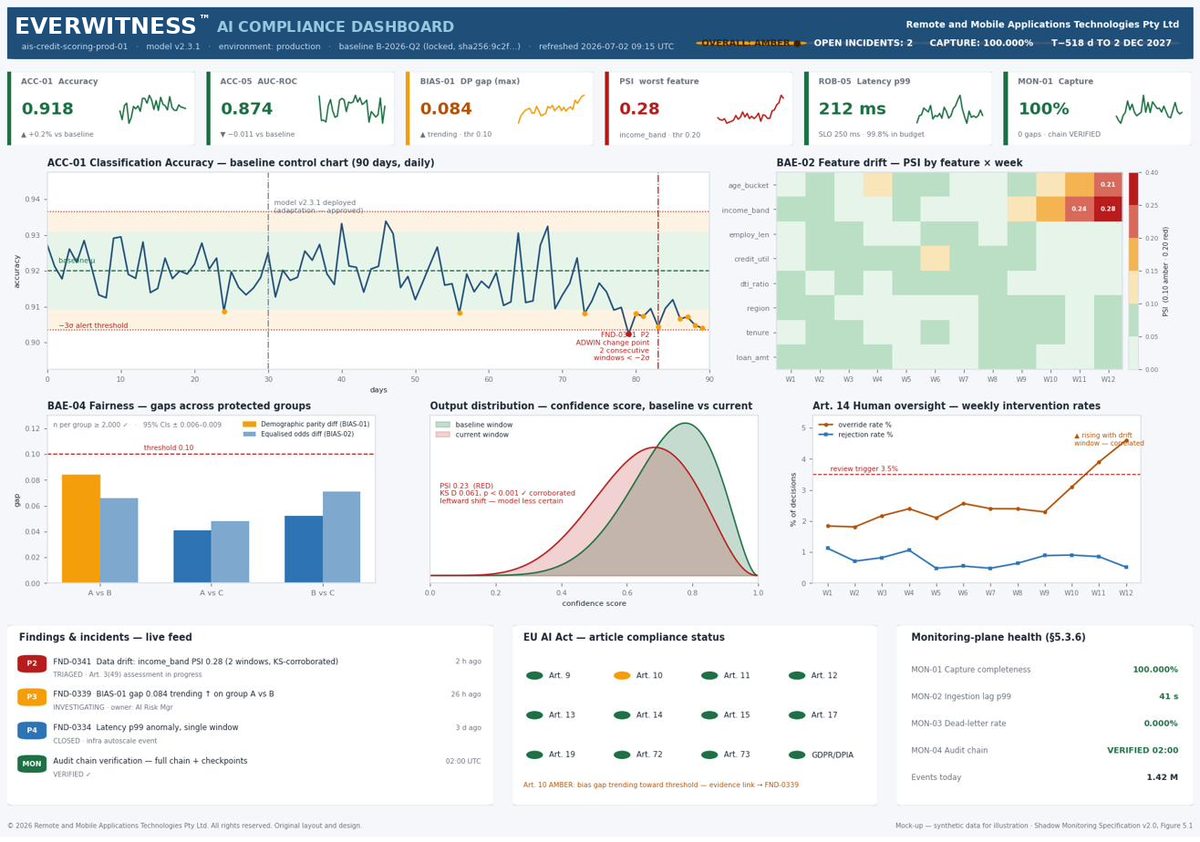
A shadow monitoring platform for high-risk AI systems. EverWitness™ sits beside your AI — never inside it, never in its way — recording every decision, checking behaviour against a locked statistical baseline, and turning that into a live compliance dashboard, a tamper-evident evidence vault, and regulator-ready reports.
Independent by design — one-way data flow; the monitored system can't silence or edit its supervisor
Built for the EU AI Act — post-market monitoring (Art. 72), record-keeping (Arts. 12 & 19), serious-incident reporting (Art. 73)
Continuous drift, accuracy and fairness monitoring across protected groups
The EverWitness™ compliance dashboard — mock-up with synthetic data
Software & apps
Applications we build and operate
Workplace safety software and the Flintzoo app platform for business and personal decisions.
Workplace health & safety
SHEQBuddy
Our flagship safety, health, environment and quality app — practical compliance workflows, incident and hazard reporting, built for businesses that need cleaner SHEQ processes without enterprise overhead.
Our app platform, home to focused tools for business and personal decisions: PayScope salary insights (compare your current salary, projection and earning potential in seconds), TaxReady, SME Accounts and the Flintzoo payment portal.
Product downloads and payments run through flintzoo.com, our distribution platform fronted by Cloudflare — fast, cached delivery worldwide with DDoS protection and TLS at the edge.
Behind the products
The capability that builds them
Everything on this page was designed, engineered and shipped by our own Build practices — AI development, application development and robotics — governed by the same disciplines we sell. That capability is available for your systems too.